Ribbons of Scarlet - Part 1: The Philospher
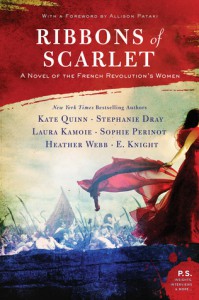
As this is a book of short stories, each focusing on one woman's perspective during the French Revolution, it only makes sense that I give each story its own review.
The first story, The Philospher by Stephanie Dray, tells us of Sophie. Mademoiselle de Grouchy (seems like an unfortunate name), is a woke woman. Let me squirrel out here for a minute. I cringed writing that sentence. I don't like the term "woke woman". It's not that I don't like what it stands for or that I disagree with the "need" for woke women, there's just something about the way it sounds that doesn't work for me. The only reason I use it here to describe Sophie is that I get the impression that's how Dray would prefer for her readers to refer to Sophie. She alludes to it more than once throughout the story. I found it problematic.
I'm not suggesting that well educated women with a desire for equality and justice for every human didn't exist in France pre-Revolution. As a matter of fact, if you look into some of the characters in and around Paris at the time, you will find that salons were littered with women who believed all humans deserved equal treatment no matter social status or gender. It was just the manner in which Dray presented Sophie that I had a problem with. The story was one huge anachronism (Spell check is letting me get away with that word.) I couldn't tell if I was reading about 18th Century France or something going on in my own back yard (We can discuss the parallels somewhere else. I will admit there are several. My point is, all of these stories are suppose to be historical.Yes, Sophie is a modern woman but she's a modern woman in 18th Century France.) She's very one dimensional. Everything should be one very specific way and that's all there is too it. Sophie needs to take off the blinders. The book's blurb suggests that this story is not the last we will see of Sophie. Maybe as the stories continue, Sophie will flesh out a little better in the hands of a different writer.
I couldn't recall if I had read any of Dray's work before. I do recall her being the subject of a bit of controversy surrounding her book on Thomas Jefferson's daughter, Patsy. Stephanie Dray's 50 shades of Jefferson/Sally Hemings Dray actually ties part of the novel into her story here. Anyway, I had to go back and check enormous read pile to see if I had read any of Dray's work prior to this. It turns out I had. Clearly it was memorable. The only thing my review of the previous work says is that I have no desire to read anything else by this author. Oops.
Up next, The Revolutionary by Heather Webb.


